Concrete time

We had our first actual city inspection to check that the rebar and foundation prep work was up to par. I guess it all went well, all I heard was that we passed and are cleared to pour the concrete into all the holes and wood frames around the house. Sometimes it takes several weeks to cure, but, apparently, since we are just adding footings and not setting up a whole new foundation we don’t have to let it cure as long before framing.

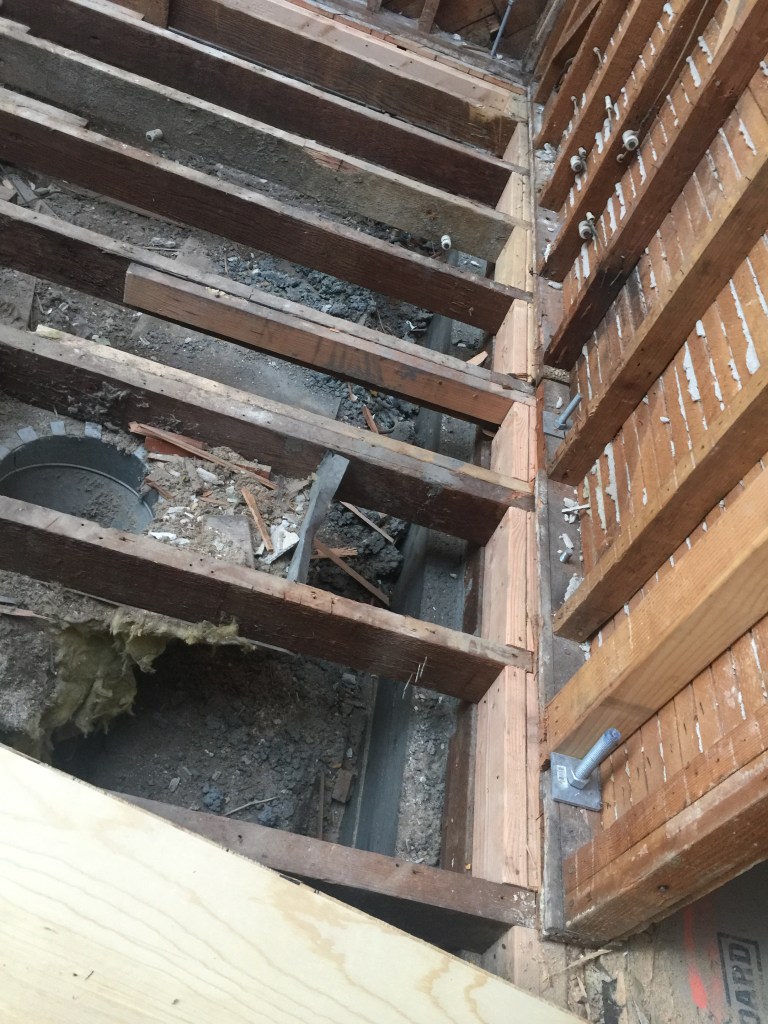
New concrete foundation and fancy bolts

I was temped to write my initials in the concrete somewhere, but all the workers were there and I didn’t want to mess anything up.

About 24 hours later they took up some of the wood scaffolding and I guess that means the concrete is pretty dry.

Basement Window-well

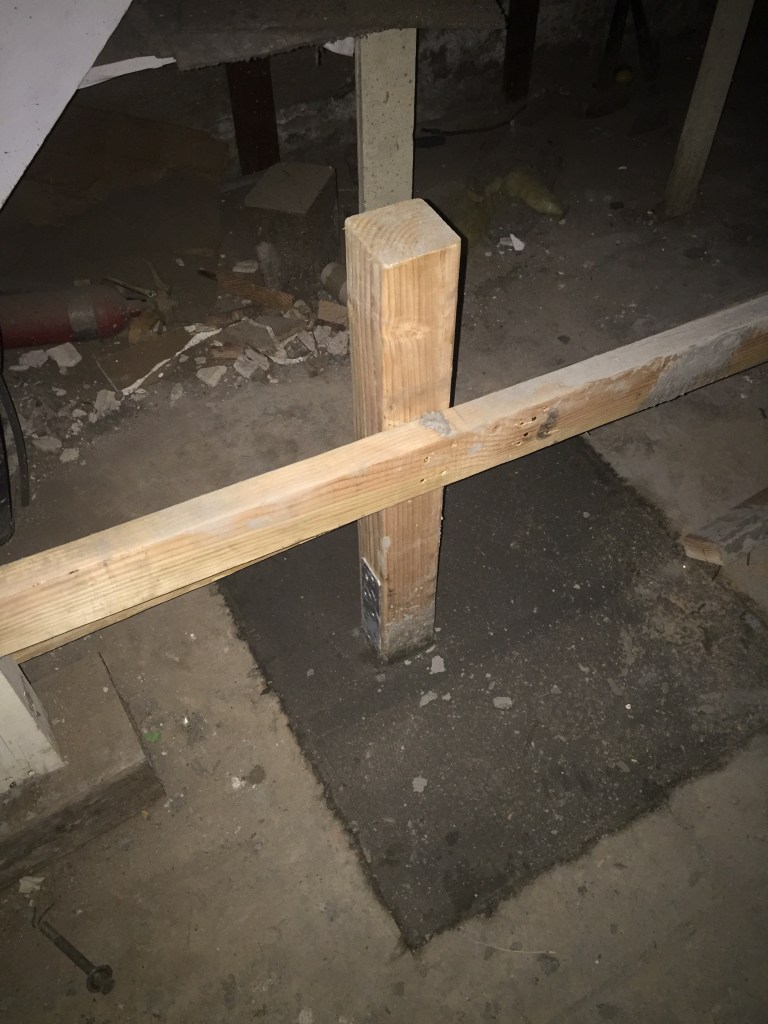
One of the footings in the basement has a beam sticking out of it that is not centered. This strikes me as weird… but the contractor assured me that it is fine…

Rain!?!?

It wasn’t in the forecast… and then it was. The back of our house is still wide open to the elements. Most of the exposed part is just framing that isn’t a big deal, but there is drywall and nice oak flooring just under the remaining roof that I am worried about. We aren’t remodeling the entire house, half of the house has to stay intact–without mold. I am worried about it, but not much I can do. We still have 6 weeks of framing and since it is mid September we will likely have more rain before it is complete. Crossing my fingers that we can at least get to a place with a rough roof and tarping before any real rain comes!

Strike!

So we stumbled on another interesting hold-up. Apparently, the new structural design needs some kind of special, custom steel bracket thing from Simpson Strongtie to hold the beams and posts together. They do custom orders… but they went on strike a few days ago and now custom order are delayed by weeks. The contractor suggested using a local steel fabricator to make it to the same specs. Going rogue from a trusted manufacturer makes me a little nervous, but I talked to the structural engineer and he said as long as specs were the same he would sign off on it, so I guess it is all good. At first I didn’t believe the contractor and thought he was trying to pull something one me, but I did confirm that they are on strike, so I guess this is just another one of those thing that happens to slightly derail projects.

Green Building

We had a Green Building inspection. I wish that I could have been there, but I wasn’t. Apparently he explained some of the requirements that were on my “GB” plan sheet (i.e. water fixture flow rates, low/no VOC materials etc). I signed this GB sheet prior to submitting for building permit application, but didn’t really understand the requirements at the time. These requirements vary for each project. We were classified as “Tier 1”, apparently because we are adding/remodeling >1000 sq ft (I don’t know how they did their math, our plans show a much smaller area). One part of this means that we have to prove that *10% of our building materials come from recycled materials.

I am conflicted on my discussion for this post. I want to love that the city is encouraging green building practices… but I am also frustrated because it is hard to figure out how to meet the requirement. The actual code details that they reference on our Green Building sheet are listed here. Interestingly they are listed as voluntary by the state of California, but I guess Palo Alto has opted to make them required.

This is an great concept and I love making green choices… the thing is… I don’t know where to find these materials! The city gives a nice spreadsheet (RCV Table 1 at the bottom of this page) for documenting and calculating your materials to make sure you reach this 10% threshold, but they don’t have ANY resources for what types of materials or what vendors you might source these materials from! I spent a few hours online and found a few options:

I think carpet, flooring underlayment and insulation are a no brainer. I am interested in the countertops and will likely give it a try, but honestly a little skeptical about durability. Tile is an option, but many of the choices are A LOT (10-50X) more expensive than what I was planning on and there are not many choices. We already have half the roof covered in composite shingles so don’t really want to redo it all and we were hoping to match the oak wood floors in the rest of the house. We may have to find a couple other options to get to that 10%.

The thing I find interesting is… hardwood flooring is technically renewable and lasts 100 years! Recycled manufactured flooring is great, but only lasts 15-20 years. I sort of feel like choosing a material with really long lasting durability is worth something from an environmental standpoint too. It is also interesting that they don’t give you credit for reused products. There are reuse centers around the Pennisula where you can purchase donated home improvement products and building materials. Quality can be low and sure, many options might not be desirable or on trend, but I do find it funny that the Green Building policy doesn’t acknowledge that it is actually much better for the environment to re-purpose a donated cabinet or light fixture in lieu of purchasing a new one made of 50% recycled particle board or plastic.

*Note: Important to keep in mind that they only count the cost of the portion of the material that is recycled (see details here). So if I spend $1000 on carpet made of 50% recycled material, I only get to count $500 for that towards my threshold. It get’s even more complicated as you have to account for pre-consumer (or post-manufacturing) and post-consumer recycled materials. You only get 50% of the credit for pre-consumer recycled material so you really have to read the spec sheets. So if the $1000 carpet I bought above was made of factory scraps from other carpets that never left the factory (i.e. pre-consumer recycled content), I might end up only getting to count $250 towards my quota.

Special Inspection

It’s still not clear to me exactly how many inspections we are required to have. This residential inspection manual outlines what is required for each inspection, not everything applies to us and I didn’t get a list specific to our project.

We are supposed to have a project coordinator at the city, and I was hoping we could become good friends and that she would be any go to for questions…unfortunately she seems to have ghosted me.  

The contractor seems to have some idea about what needs to happen so he scheduled the special inspection.  As far as I can tell from this part of the residential inspection guide, the special inspection can be anyone who meets so the criteria. It turns out our structural engineer can be our special inspector. He has to come by and check that some bolts are properly installed into the foundation. He did his inspection, then sent us another bill for $400.


Next up is the Green Building inspection and then the Foundation Inspection. We have to get this done by a city building inspectors before he can pour the concrete foundation.  

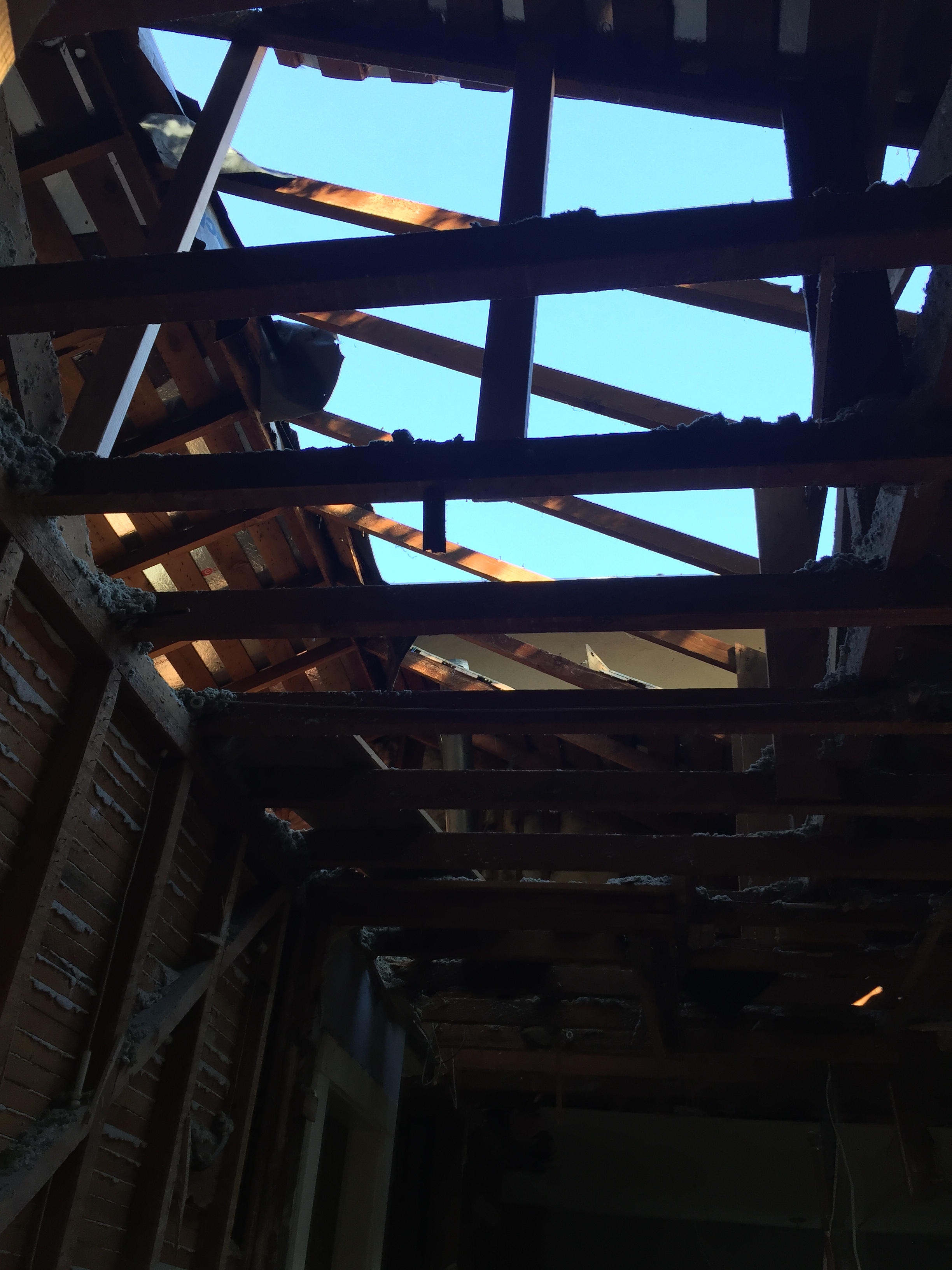
A view of the stars

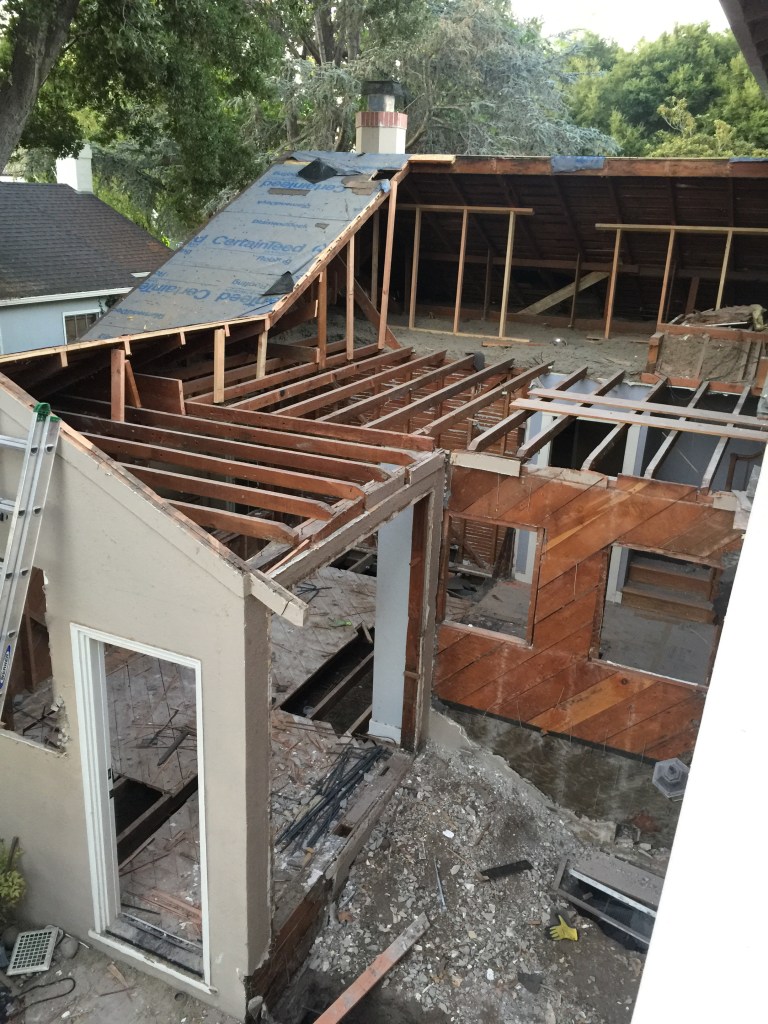
They took off the roof this week.

This is the scariest part of the process for me because:

1) the whole house is exposed to the weather now

2) ) it looks like house could just cave in

The contractor told me he thought the house would only be open like this for about 2 weeks. It’s been 5 days and they haven’t started framing yet so I’m not sure I buy that. Luckily the 10 day forecast looks clear so I think we have time. September in Palo Alto isn’t usually rainy, but there’s is definitely a chance of rain which doesn’t exist from June-August.  

The wood for framing is supposed to come tomorrow, but we still have to get through a special inspection first. 

Surprises in the walls

I think it happens to everyone, for sure if you have an old house. The architect does their best to estimate where the existing beams, pipes, and floor joists are… but they can’t always tell and old plans don’t always have that info. When they opened up the walls in our house they beams were not where we expected and the last remodel and done something funky by stacking the beam on the top of the floor joists (or something like that) which meant that now the floor joists for the new upstairs room needed to be twice as tall in order to match. This type of change requires us to submit a plan change to the building department. This is what we had to do:

  1. The contractor, architect, and the structural engineer discuss the situation and make a plan to correct for the issues. (Luckily, in this case, they were super fast and there was a straightforward, not too expensive, alternative.)
  2. The structural engineer and architect produce a new plan sheet and calcs.
  3. Someone (usually contractor–but I went as well) takes the revised plan sheets AND new CALCS to the building dept (we forgot the the calcs the first time… which means two trips–ugh). Apparently sometimes you need a signed letter describing why you are making the change… depends on the building inspector you get.
  4. The building reviewer at the city opens a plan revision and reviewed our changes. We had to pay a fee of around $100. Luckily this was simple enough that they are able to give you an “a-OK” stamp right there over the counter. (You don’t have to want 2 weeks for a review.)
  5. Then you get back to work executing the new plans.

Wondering how many more of these we will have to do…

JADU considerations

In 2017, the state of California issued some new land use bills that made it easier for (and even incentivized) homeowners to build Accessory Dwelling Units (ADUs).

Each city was tasked to update their local codes and guidance to meet the new state requirements. The government keeps tweaking the guidelines so they change a little here and there, but this flyer is a great overview. The full details of the ordinance (as of today anyway) are here.

We were back and forth on the JADU over our year of designing. Here is what I came up with for some pros and cons:

PROS

  1. up to 50 additional sq ft of building (this is HUGE if you are limited for a small lot)
  2. could make a nice extra source of income (could make a REALLY nice source of income if you moved into the JADU in retirement and rented the rest of the house…)
  3. makes a super nice guest room for visitors (but hopefully not nice enough to encourage the kids to hang around and use it as a free apartment after they graduate high school!)

CONS

  1. it’s officially a JADU per county records (we had go down to San Jose and sign a deed restriction (to get through planning) and you have to assign a separate street address to the JADU (I am not sure how we do this yet…)
  2. it’s a little fuzzy what would happen down the line you remodeled again and removed the JADU… do you have to give back the 50 sq ft?
  3. is it awkward to have a kitchenette in room that we will likely just use a teen bedroom for a few years?

Ultimately the pros win! I think it is cool. It will be fun to design a studio apartment, and I think it will actually be super fun for my teen daughter to have her own kitchenette to practice for dorm life.

A little more about the deed restriction…it doesn’t look too bad, mostly we were just worried how it ultimately lands from a resale perspective–since most people don’t like restrictions!

DEED RECORDING NOTE: To avoid a return trip to the county (like we did)…make sure that if you are married you write both full names in the template text (I wrong “Jane and John Doe”–this is incorrect). Also if you include an old map from your old deed make sure it is completely legible. Lastly, make sure you bring 3 copies (unless you want to bring some dimes and use the machine there)!

The deed restrictions we signed sum up to:

  • we can’t sell the JADU separately from the house
  • we (property owners) have to a) live in either the main house, b) live in the JADU, or c) rent the whole house to one tenant (family) as long as we expressly forbid the tenant from subletting the JADU to another party–basically we just can’t rent it out like a duplex to two separate families.
  • rentals must be >30 days (no short term rentals)
  • this restriction applies to all future property owners

There is a separate deed restriction link for the full (detached) ADU but it looks exactly the same as the JADU one as far as I can tell.

The sky is the limit

the design stage

So this is the fun part.  You can “build” anything you want when you are drawing it out on paper.  Sketches don’t care about sheer walls, or daylight planes.  Sketches don’t care how much it costs to move sewer lines or replace tile floors. Sketches also don’t care where the city draws your property line or special set-back.

Our goals were:

  • add a master bedroom and bathroom upstairs
  • enclose a weird ground floor patio area of the back of the house
  • clean up the basement (currently only had 4 foot walls open to the crawlspace and partially drywalled–we used it for storage/utilities but it was dank and creepy down there)

We spent nearly a year finalizing our plan.  Our process went like this:

1) look up our parcel report here:  http://xmap.cityofpaloalto.org/parcelreports/  The report lists some basic limits of your lot (like max floor area, easements, and set-backs etc)

2) have a meeting with architect to sketch out all the possible ideas we can think of that fall within the limits of our parcel report 

3) stop by the building department to clarify questions that come up with our funky old home

4) meet back with the architect because we have more limits than we thought

5) repeat steps 3 & 4…for nearly two years.

If you want to nitty gritty–specifics that that limited us on our design plan:

  • We have a relatively small lot (5600 sq ft).  
  • Our lot is on a busy road (special set-backs in the front of the house).
  • We share a private alley/driveway in the rear of the house with 4 other neighbors, but the driveway sits largely within our property lines (this creates gray area on rear set backs…does it start at the property line or the alley…does this set-back affect our maximum floor area or just our building area…the city didn’t even have the alley on our parcel report…)
  • Our existing house sits within the side yard set-backs in some areas (grand-fathered in)
  • Our neighbor has some large heritage oaks (the trees are just over the property line, but their roots and canopy are on our partially on our property so we have to accommodate them). 

Our main discussion was regarding the maximum square footage we could build because of the alley situation.  Our existing house comes in at 2100 sq ft (including the garage which is how the city calculates it).

First they said we were limited to 2,250 sf total building area (including garage).  A kind planner, perhaps feeling bad about bursting my remodel bubble, shared a flyer summarizing the new 2017 ADU incentives –if you convert an existing bedroom to a Junior ADU (i.e. add a mini kitchen sink and counter-top area) the city will allow you to add up to 50 additional sq ft over your maximum floor area to accommodate the JADU.  We could just barely create our new upstairs bedroom/bath and downstairs mudroom with this amount so we created a full set of plans, with engineering to cover 2300 sf total building area (new addition of about 200 sq ft). 

Then as we got through the first round of planning reviews, we learned that: maybe the driveway doesn’t limit us after all, maybe we are eligible for the full 2438 sq ft. floor area listed on our parcel report, and if we stick with the JADU idea (that was growing on us at this point for a few reasons), we can get up to nearly 2490 sf (i.e. over 350 sf addition = much bigger bedroom and bathroom upstairs).  We revised the plans, redid (re-paid!) the structural engineering plans and after what felt like FOREVER, resubmitted our plans for a planning review.  

In the end we were limited by daylight planes and the stairwell location for our upstairs addition so didn’t end up maxing out all available buildable sq footage afterall.

….and that is how we took nearly two years to prepare a design plan for a *simple* 350 sq ft addition. 

Picking an architect

So let’s flash back to the beginning…architect interviews.  We talked to a design-build guy with flashy tri-fold fliers, a fancy-pants firm that specialized in restoring historic homes (we were basically laughed out of that office–our home is old, but not really “historic”), a freshly-out-of-architecture-training dreamer babbling about 3d rendering, and a guy with a roll of tracing paper and a drafting ruler.  We went with the tracing paper guy, he was referred to us from a co-worker.  

I am no expert in this. We have hired a sum total of two contractors and 1 architect in our life. I am sure there are lots of discussions online comparing the pros and cons of different options and likely you will (and should) choose an architect that you have a personal referral for, but here are my two cents.

Handling Design Puzzles

Our architect had many years of experience that resulted in good ideas for how to puzzle piece things together within the available footprint.

Budget

We were WAY off on budget estimates. The architect just really couldn’t speculate on cost and unfortunately you can’t really even get a contractor quote until after the building and structural plans are complete. At this point you have already sunk at least 20-30K (if not more!) into the project and it’s more expensive to make changes to reduce budget. A design build firm may have been able to help us understand the budget considerations of building from the beginning–even if there’s not much we could do about it. In our case I don’t think we really had too much choice about where to place the new upstairs room, but we were definitely scrambling for loans once the real estimates started coming in. Unfortunately, once you sign with a design build firm, depending on the terms, you might be stuck with them for the long haul while and architect will sign off the plans to any contractor you choose. This allows you to shop the plans around and get a really feel for the range of costs out there.

Subject Matter Experts

One last argument for using separate designer and contractor is that between building code, planning requirements, and structural components, I would assume it is really hard to be an expert in all aspects of a home remodel. I can appreciate a contractor that really knows his stuff when it comes to accurately following a plan, getting the right materials, and knowing how to talk to inspectors, just as I can appreciate an architect that knows roof angles, site planning restrictions, and optimum layout options like the back of his hand.


If we were to do it again, I am still not sure what we do. Realistically the best option probably has more to do with how SUPER familiar someone is with the local building codes, permit process, and guidelines. If it’s a simple addition, and budget is a big factor, then design-build might be the way to go.