JADU considerations

In 2017, the state of California issued some new land use bills that made it easier for (and even incentivized) homeowners to build Accessory Dwelling Units (ADUs).

Each city was tasked to update their local codes and guidance to meet the new state requirements. The government keeps tweaking the guidelines so they change a little here and there, but this flyer is a great overview. The full details of the ordinance (as of today anyway) are here.

We were back and forth on the JADU over our year of designing. Here is what I came up with for some pros and cons:

PROS

  1. up to 50 additional sq ft of building (this is HUGE if you are limited for a small lot)
  2. could make a nice extra source of income (could make a REALLY nice source of income if you moved into the JADU in retirement and rented the rest of the house…)
  3. makes a super nice guest room for visitors (but hopefully not nice enough to encourage the kids to hang around and use it as a free apartment after they graduate high school!)

CONS

  1. it’s officially a JADU per county records (we had go down to San Jose and sign a deed restriction (to get through planning) and you have to assign a separate street address to the JADU (I am not sure how we do this yet…)
  2. it’s a little fuzzy what would happen down the line you remodeled again and removed the JADU… do you have to give back the 50 sq ft?
  3. is it awkward to have a kitchenette in room that we will likely just use a teen bedroom for a few years?

Ultimately the pros win! I think it is cool. It will be fun to design a studio apartment, and I think it will actually be super fun for my teen daughter to have her own kitchenette to practice for dorm life.

A little more about the deed restriction…it doesn’t look too bad, mostly we were just worried how it ultimately lands from a resale perspective–since most people don’t like restrictions!

DEED RECORDING NOTE: To avoid a return trip to the county (like we did)…make sure that if you are married you write both full names in the template text (I wrong “Jane and John Doe”–this is incorrect). Also if you include an old map from your old deed make sure it is completely legible. Lastly, make sure you bring 3 copies (unless you want to bring some dimes and use the machine there)!

The deed restrictions we signed sum up to:

  • we can’t sell the JADU separately from the house
  • we (property owners) have to a) live in either the main house, b) live in the JADU, or c) rent the whole house to one tenant (family) as long as we expressly forbid the tenant from subletting the JADU to another party–basically we just can’t rent it out like a duplex to two separate families.
  • rentals must be >30 days (no short term rentals)
  • this restriction applies to all future property owners

There is a separate deed restriction link for the full (detached) ADU but it looks exactly the same as the JADU one as far as I can tell.
The sky is the limit

the design stage

So this is the fun part.  You can “build” anything you want when you are drawing it out on paper.  Sketches don’t care about sheer walls, or daylight planes.  Sketches don’t care how much it costs to move sewer lines or replace tile floors. Sketches also don’t care where the city draws your property line or special set-back.

Our goals were:

  • add a master bedroom and bathroom upstairs
  • enclose a weird ground floor patio area of the back of the house
  • clean up the basement (currently only had 4 foot walls open to the crawlspace and partially drywalled–we used it for storage/utilities but it was dank and creepy down there)

We spent nearly a year finalizing our plan.  Our process went like this:

1) look up our parcel report here:  http://xmap.cityofpaloalto.org/parcelreports/  The report lists some basic limits of your lot (like max floor area, easements, and set-backs etc)

2) have a meeting with architect to sketch out all the possible ideas we can think of that fall within the limits of our parcel report 

3) stop by the building department to clarify questions that come up with our funky old home

4) meet back with the architect because we have more limits than we thought

5) repeat steps 3 & 4…for nearly two years.

If you want to nitty gritty–specifics that that limited us on our design plan:

  • We have a relatively small lot (5600 sq ft).  
  • Our lot is on a busy road (special set-backs in the front of the house).
  • We share a private alley/driveway in the rear of the house with 4 other neighbors, but the driveway sits largely within our property lines (this creates gray area on rear set backs…does it start at the property line or the alley…does this set-back affect our maximum floor area or just our building area…the city didn’t even have the alley on our parcel report…)
  • Our existing house sits within the side yard set-backs in some areas (grand-fathered in)
  • Our neighbor has some large heritage oaks (the trees are just over the property line, but their roots and canopy are on our partially on our property so we have to accommodate them). 

Our main discussion was regarding the maximum square footage we could build because of the alley situation.  Our existing house comes in at 2100 sq ft (including the garage which is how the city calculates it).

First they said we were limited to 2,250 sf total building area (including garage).  A kind planner, perhaps feeling bad about bursting my remodel bubble, shared a flyer summarizing the new 2017 ADU incentives –if you convert an existing bedroom to a Junior ADU (i.e. add a mini kitchen sink and counter-top area) the city will allow you to add up to 50 additional sq ft over your maximum floor area to accommodate the JADU.  We could just barely create our new upstairs bedroom/bath and downstairs mudroom with this amount so we created a full set of plans, with engineering to cover 2300 sf total building area (new addition of about 200 sq ft). 

Then as we got through the first round of planning reviews, we learned that: maybe the driveway doesn’t limit us after all, maybe we are eligible for the full 2438 sq ft. floor area listed on our parcel report, and if we stick with the JADU idea (that was growing on us at this point for a few reasons), we can get up to nearly 2490 sf (i.e. over 350 sf addition = much bigger bedroom and bathroom upstairs).  We revised the plans, redid (re-paid!) the structural engineering plans and after what felt like FOREVER, resubmitted our plans for a planning review.  

In the end we were limited by daylight planes and the stairwell location for our upstairs addition so didn’t end up maxing out all available buildable sq footage afterall.

….and that is how we took nearly two years to prepare a design plan for a *simple* 350 sq ft addition. 

Picking an architect

So let’s flash back to the beginning…architect interviews.  We talked to a design-build guy with flashy tri-fold fliers, a fancy-pants firm that specialized in restoring historic homes (we were basically laughed out of that office–our home is old, but not really “historic”), a freshly-out-of-architecture-training dreamer babbling about 3d rendering, and a guy with a roll of tracing paper and a drafting ruler.  We went with the tracing paper guy, he was referred to us from a co-worker.  

I am no expert in this. We have hired a sum total of two contractors and 1 architect in our life. I am sure there are lots of discussions online comparing the pros and cons of different options and likely you will (and should) choose an architect that you have a personal referral for, but here are my two cents.

Handling Design Puzzles

Our architect had many years of experience that resulted in good ideas for how to puzzle piece things together within the available footprint.

Budget

We were WAY off on budget estimates. The architect just really couldn’t speculate on cost and unfortunately you can’t really even get a contractor quote until after the building and structural plans are complete. At this point you have already sunk at least 20-30K (if not more!) into the project and it’s more expensive to make changes to reduce budget. A design build firm may have been able to help us understand the budget considerations of building from the beginning–even if there’s not much we could do about it. In our case I don’t think we really had too much choice about where to place the new upstairs room, but we were definitely scrambling for loans once the real estimates started coming in. Unfortunately, once you sign with a design build firm, depending on the terms, you might be stuck with them for the long haul while and architect will sign off the plans to any contractor you choose. This allows you to shop the plans around and get a really feel for the range of costs out there.

Subject Matter Experts

One last argument for using separate designer and contractor is that between building code, planning requirements, and structural components, I would assume it is really hard to be an expert in all aspects of a home remodel. I can appreciate a contractor that really knows his stuff when it comes to accurately following a plan, getting the right materials, and knowing how to talk to inspectors, just as I can appreciate an architect that knows roof angles, site planning restrictions, and optimum layout options like the back of his hand.


If we were to do it again, I am still not sure what we do. Realistically the best option probably has more to do with how SUPER familiar someone is with the local building codes, permit process, and guidelines. If it’s a simple addition, and budget is a big factor, then design-build might be the way to go.

There shall be light

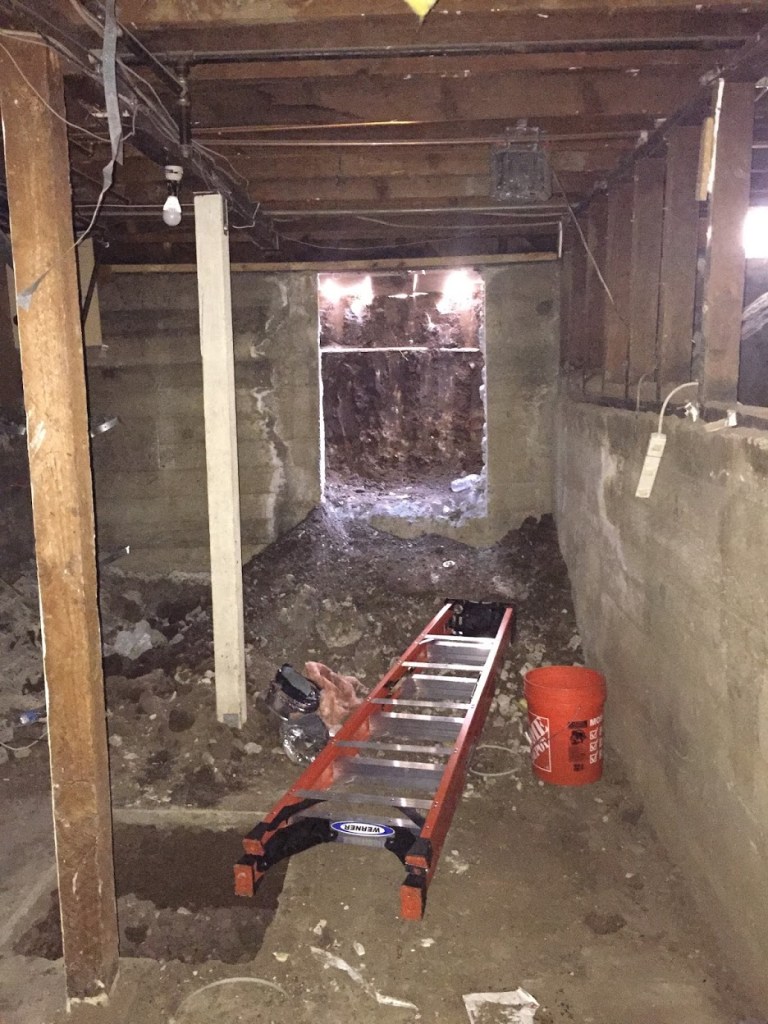
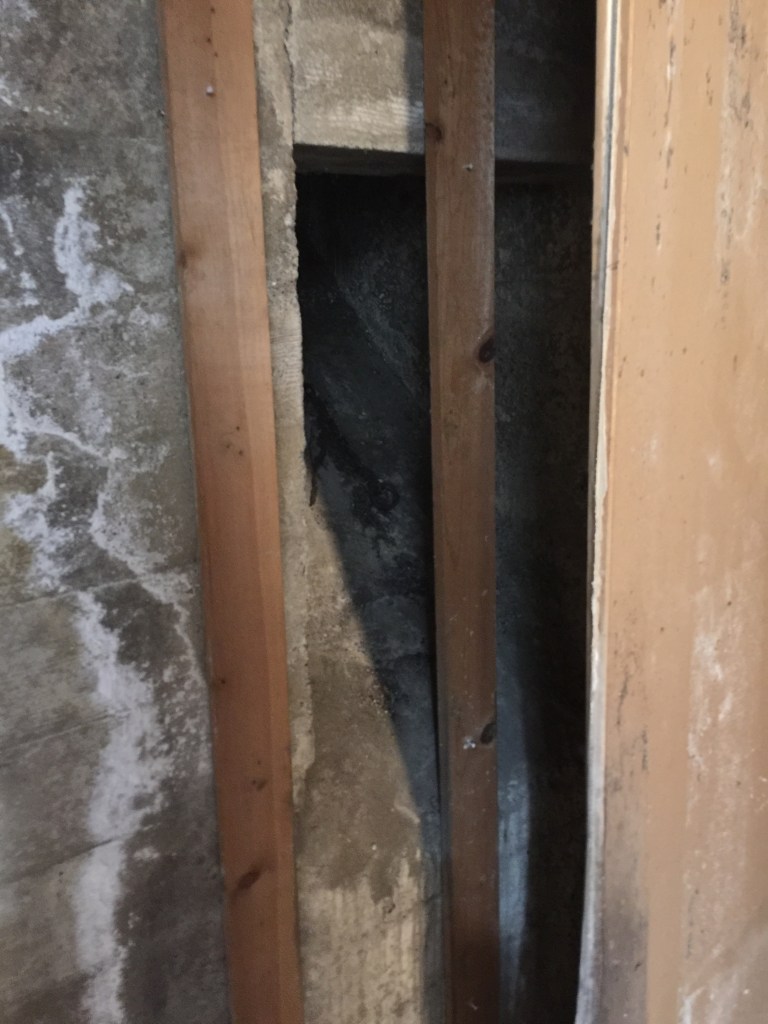
When we moved in there was rough drywall around three of the basement walls. We saw a little water dribbling in whenever it rained, so out of curiosity one day I pulled back the drywall to see what was going on. I was sure I would find a gross moldy mess, but it was actually just a bunch of dirt and lots of snail shells(?)– oh ya, and a big friggin hole in the wall! I can’t believe we didn’t get more water in there with that big hold in the foundation wall. So I took a few pictures of the hole and then returned the drywall back to it’s original location. That wasn’t going to be a DIY job!

After googling a bit I found out that in the old days, when furnaces ran on coal, houses had a “coal chute” on the side of the house. The chute was like a mail box, but for coal. Apparently the coal delivery man would just drive up and dump your coal down the chute. Then (I guess) the home owner would go down in the basement every once in a while and shovel the coal into the furnace.

(Side note, we also found some remnants of the old furnace behind the drywall. Some portion of brick wall anyway–I was hoping for something a little more exciting–like something that could become a little hidey-hole or something. Oh well. )

This had something to do with the original furnace (I guess?)

Somewhere in the mid-century the original home owners must have converted to a gas furnace and, since they no longer had any use for the chute (and probably because it leaked water into the basement a bit when it rained), they poured a big concrete “plug” over the top of the chute door. This “plug” didn’t quite fill the entire hole in the wall though.

Obviously I immediately started thinking about turning this hole in the wall into a window. I mean, there’s already a huge hole!? How hard could it be? So I mentioned it to the architect and into the plans it went! We used the basement for storage, but wanted to do finish off the basement in a simple way, just to make the space less like a creepy troll hole.

After the guys removed all the drywall
Super Creepy right??

So they were jack hammering the crap out of that thing… and now we have the beginnings of a basement egress window!!

Dirt

So much digging. So much dirt. 

The second floor addition requires a lot of foundation work. They have to tear out sections of the floor in order to dig out the holes for the new bigger concrete footings needed to carry the added load.

Ground Floor Bedroom (this was a closet)

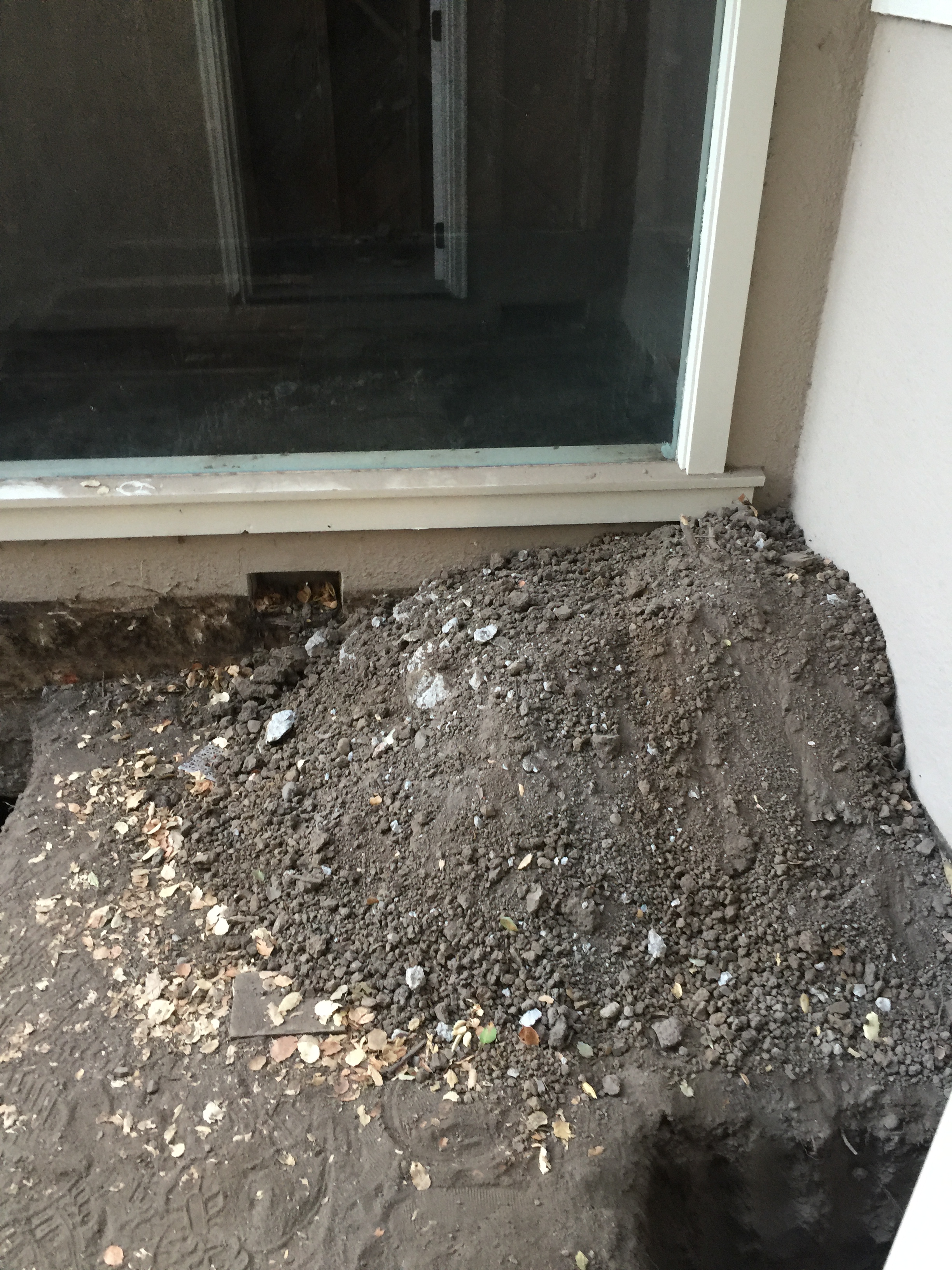
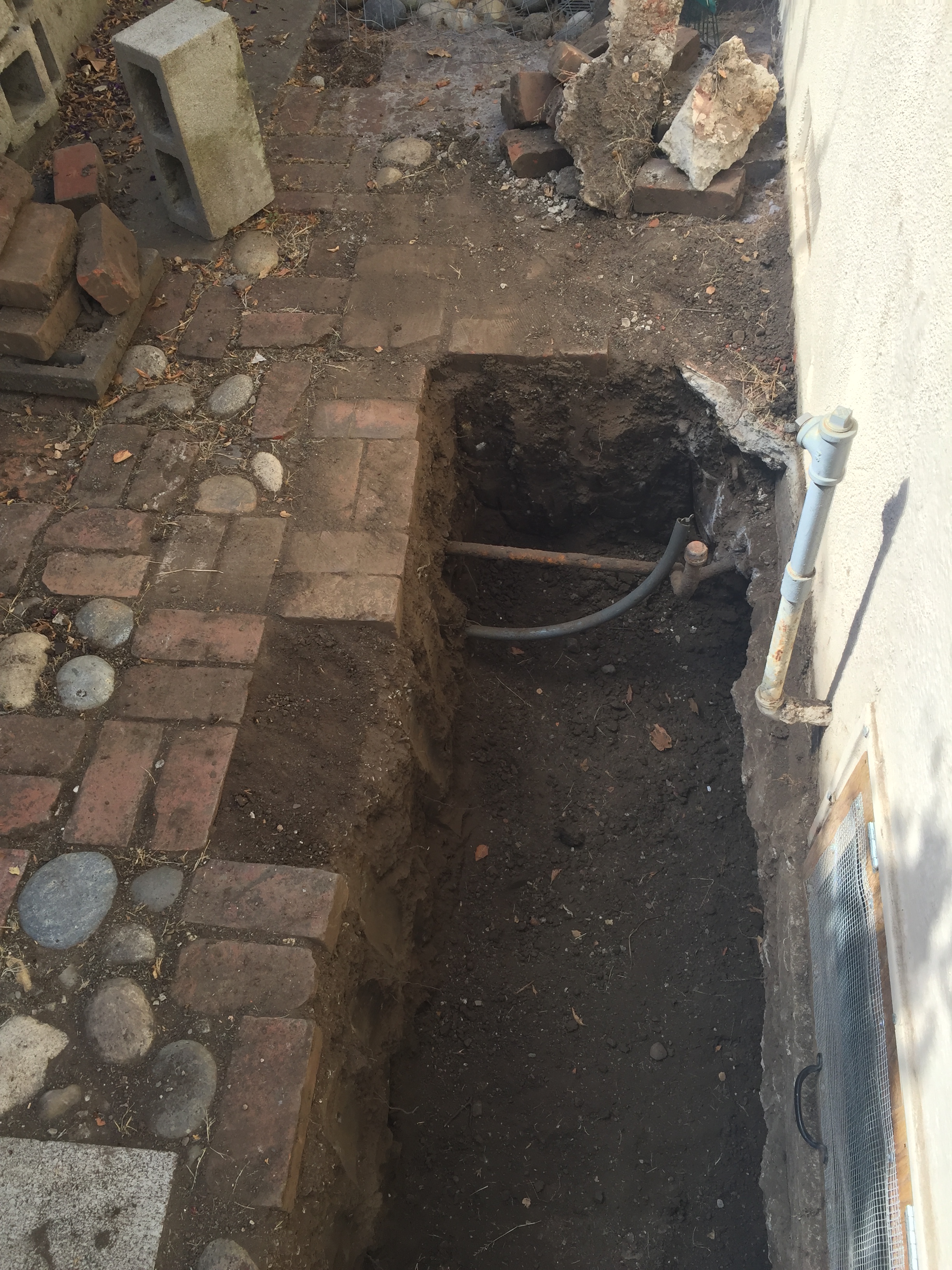
We are also digging out a “nook” in the crawl space so that the furnace can go under the house instead of taking up floor space in the small basement. (I like that, I’m going to call it my furnace nook from now on.) Unfortunately all of this dirt has to come out by hand. It’s hard work for these guys. They dug out an access portion in the side yard in order to avoid taking every bucket of dirt up the stairs.   (This is also where the gas line is–don’t worry, we had it shut down at the street by utilities before we started demo work.)


Side Yard excavation at foundation–that also happens to be the gas line, two of them(?)…hopefully the utility guys will work that out…

Basement Wall after demo–but before removing extra dirt
The Furnace Nook (I know, it’s not all that impressive yet–but they did take out a good -sized pile of dirt!)

Day 1: Demo Day

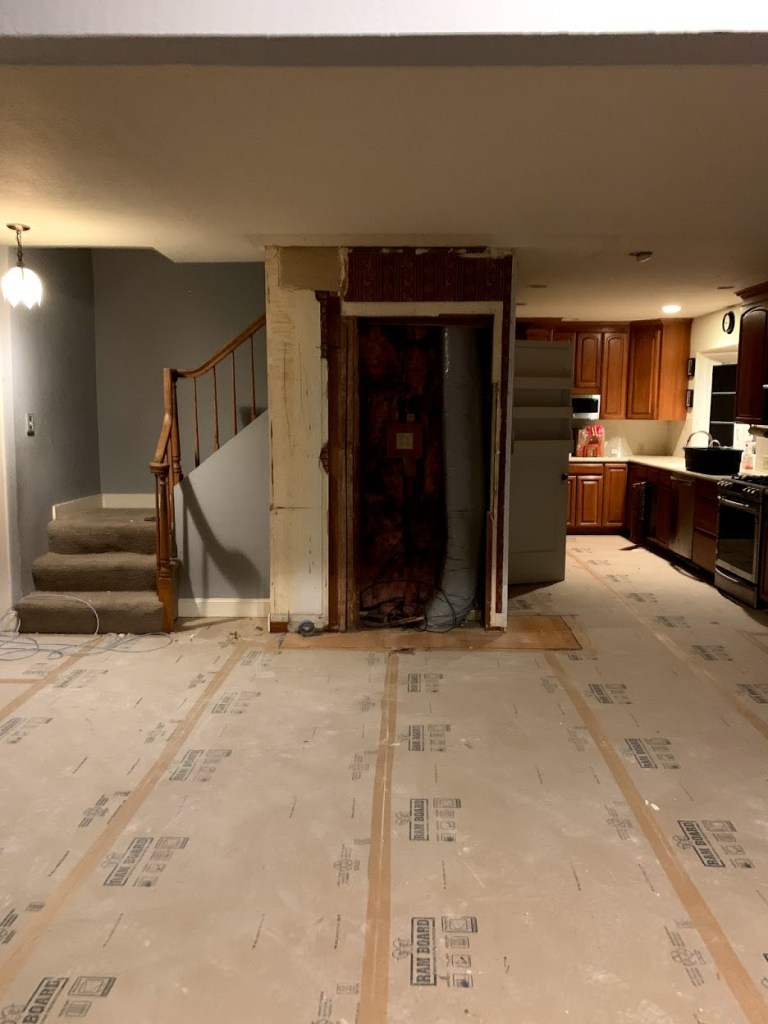
The dumpster was delivered and the guys got to work. Lots of walls are gone, carpet is gone, the custom bookshelf hand-made by the previous own–gone but that didn’t quite fit our TV… gone!

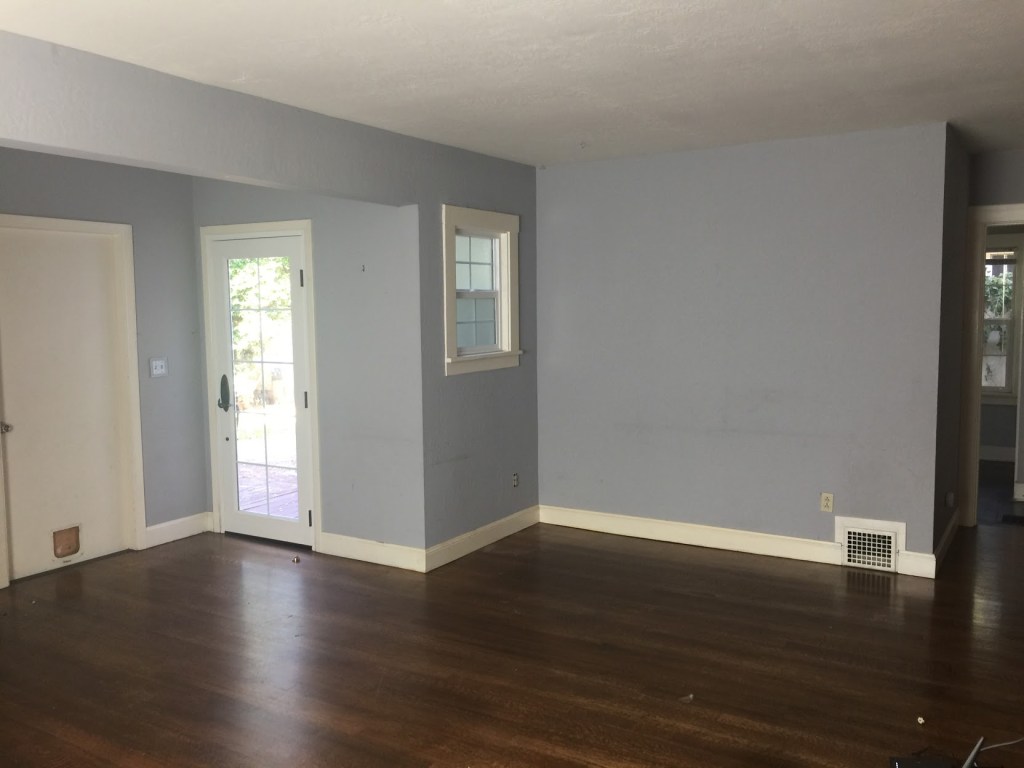
Family Room (Before)
Family Room (After Demo)
Family Room (Before)
Family Room (After Demo of Master Bathroom)
Master Bedroom (Before)
Master Bedroom (After Demo)
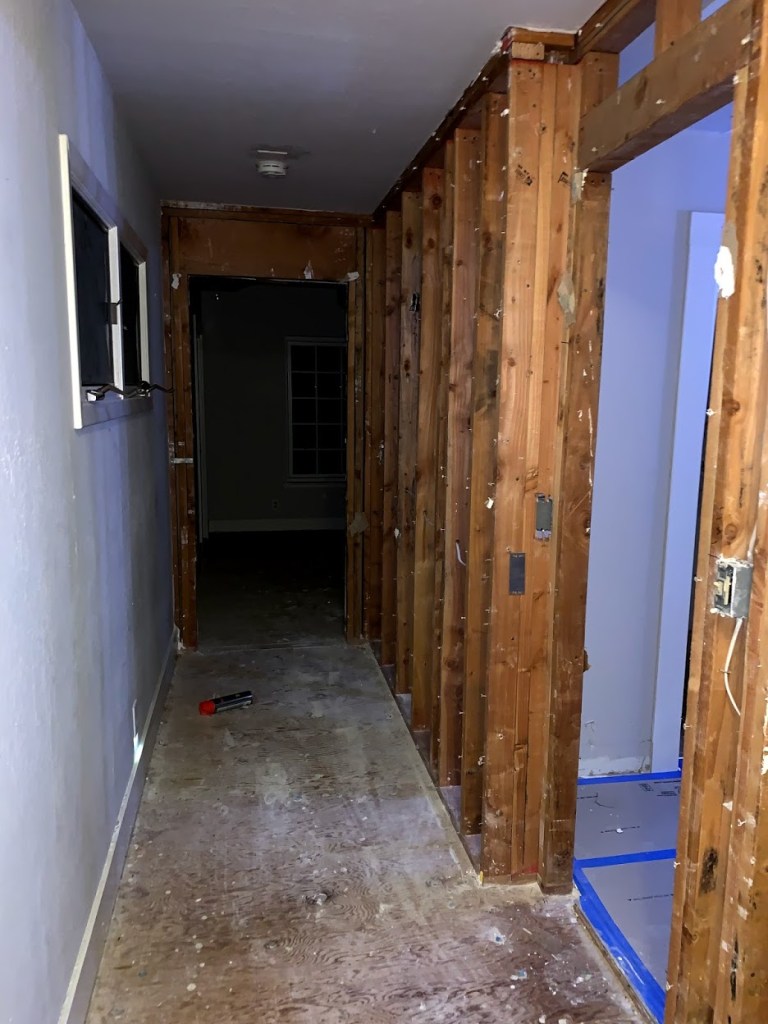
Upstairs Hallway (Before)
Upstairs Hallway (After Demo)

A note on construction waste. Apparently, Greenwaste of Palo Alto has EXCLUSIVE rights to pick up all waste generated in Palo Alto. Because waste service varies so much from company to company and city to city our contractor conveniently left that out of his budget estimate. So I called up as the home owner to order a “debris container” from them. (Customer service is super nice by the way! They are quick to answer questions and service was really easy and fast to set up!)

Of course, because nothing construction related is easy with our lot, we actually don’t have a place for the dumpster on our lot (tall hedges, shared alley, brick walls etc.). Therefore, we had to beg and plead with public works to get an “encroachment permit” in order to park our dumpster on the street. There are LOTS of restrictions on this which are clearly listed on the form. We also had to submit a sketch showing exactly where the dumpster was to be placed and had to demonstrate in the drawing that all the conditions were met. Unlike many nearby cities, Palo Alto REALLY does not want residents parking construction dumpsters on the street. Luckily, our situation was dire enough (a building inspector even drove by the house the confirm!) that they allowed us a permit for a 2-week window.

Two week encroachment Permit Cost: $783

Two week dumpster rental (including refuse pick up): around $1000

Something is finally happening!

We moved out of our modest Palo Alto home 20 days ago in anticipation of a construction start date.  That start date came and went while we metaphorically burned our money in the “cozy”, “charming” rental house as our home sat empty.

But today–today something is finally happening!  There is wood in the garage, cardboard on the hardwood floors, and orange spray paint on the walls.  Demo day is tomorrow.